
THE FOLLOWING GUIDE WILL HELP YOU IDENTIFY DIFFERENT GAS METER MODELS
You need the right size gas meter for your business. If your meter is bigger than you need, you could be paying hundreds or thousands of pounds in additional standing charges. Too small and you could find your gas equipment operating unsafely, inefficiently or incorrectly.
To help you identify what capacity gas meter you have, we provide a simple guide below. Meters carry a meter serial number and details of its capacity and measurement class on the fascia. The model number may begin with the letter U or E, followed by a digit. The example below shows the meter size and capacity on the dial. There are exceptions, particularly with older meters that use imperial measurements.
What do Qmax and Qmin mean?
Q max and Qmin refer to the maximum and minimum flow rates that the meter can operate within the limits of maximum permissible error. Qmax identifies the meter size which can be stated in m3 or cubic feet.
e.g. a meter displaying Qmax = 16 m3/h is a U16 meter with a peak flow of 16 m3 per hour.
This list show the main low-pressure meters and their maximum flow rates.
To identify the size you require you need the maximum combined requirements of your gas appliances which are usually stated in reference literature or on the ID plate of the appliance in Kilowatts (Kw). If in doubt please consult a local Gas Safe Engineer at https://www.gassaferegister.co.uk/

The illustrations below show examples of different types of meters and how the meter type and capacity can be identified.
If you’d like help identifying your gas meter please contact us.
You can find the full range of low-pressure commercial gas meters here.
EXAMPLE 1
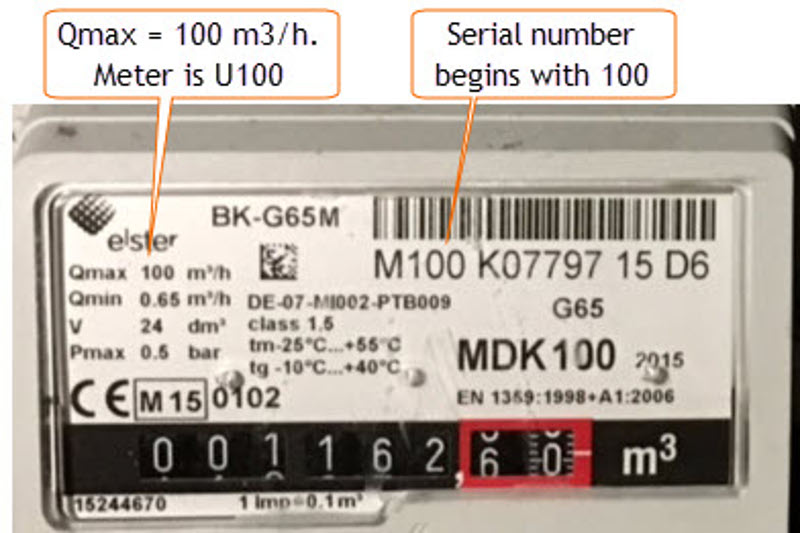
This meter’s capacity is Qmax 100 m3/h. Sometimes, particularly in more modern meters, the first 2 or 3 digits of the serial number also indicate the meter size.
EXAMPLE 2
The following example is a metric meter displaying Q max = 6 m3/h. This identifies the meter as a U6, with a peak flow of 6 m3/h. The meter serial number does not help in this case.

EXAMPLE 3
The Qmax of the meter below is 40 m3/h and the serial number begins with 040. This indicates it is a U40 meter.
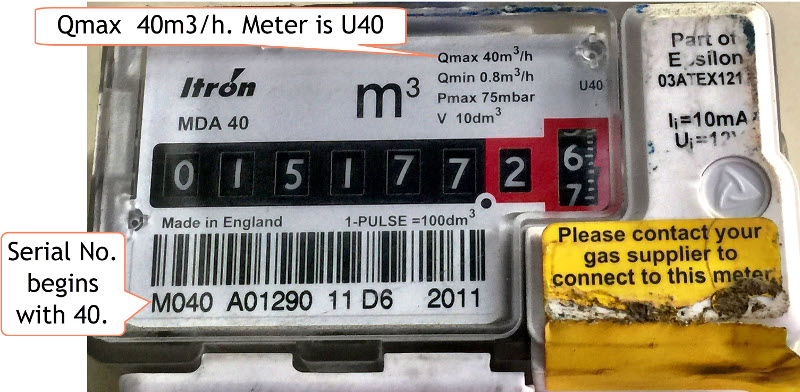
If you need help in identifying your gas meter call us, and we will assist you.
Some older gas meters use imperial measurements instead of metric, and these can be more difficult to identify and size. The answer is to convert cubic feet into cubic metres. The table shown above provides both metric and imperial flow rates.
If you are having problems with this either call us, or send us a photo of the meter, and we will identify the meter, its peak capacity, and whether it is suitable for your requirements.
EXAMPLE 4
The maximum capacity of the meter below is 3,531 cubic feet per hours. This converts into 99.9 cubic metres which is equal to a Q max of 100 m3/h, indicating this is a U100 meter.
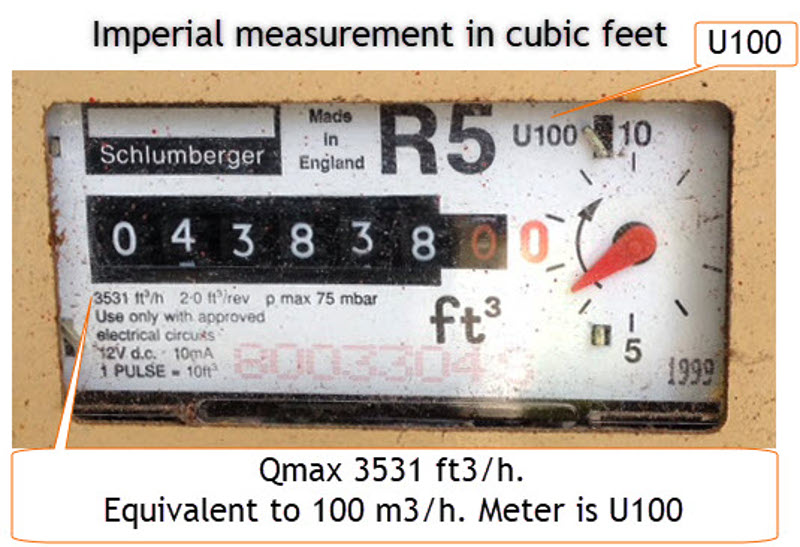
EXAMPLE 5
The meter below shows a maximum capacity of 883 cubic feet per hour. This converts into 25 m3/h and means this is a U25 meter.

Gas Connections can help you identify your meter size and model by searching the national database, or with a photograph or recent gas bill.
Do you need help identifying your Meter Point Reference Number (MPRN). You can find it here:
When applying for a Commercial Gas Service Alteration you will need to identify your current meter size.
Do you need a new gas meter or gas connection? Call Gas Connections and get connected fast.